
Photo by Matt Stepp
From Trees to Trails: Scout-Focused Conservation
By Heidi Wakefield
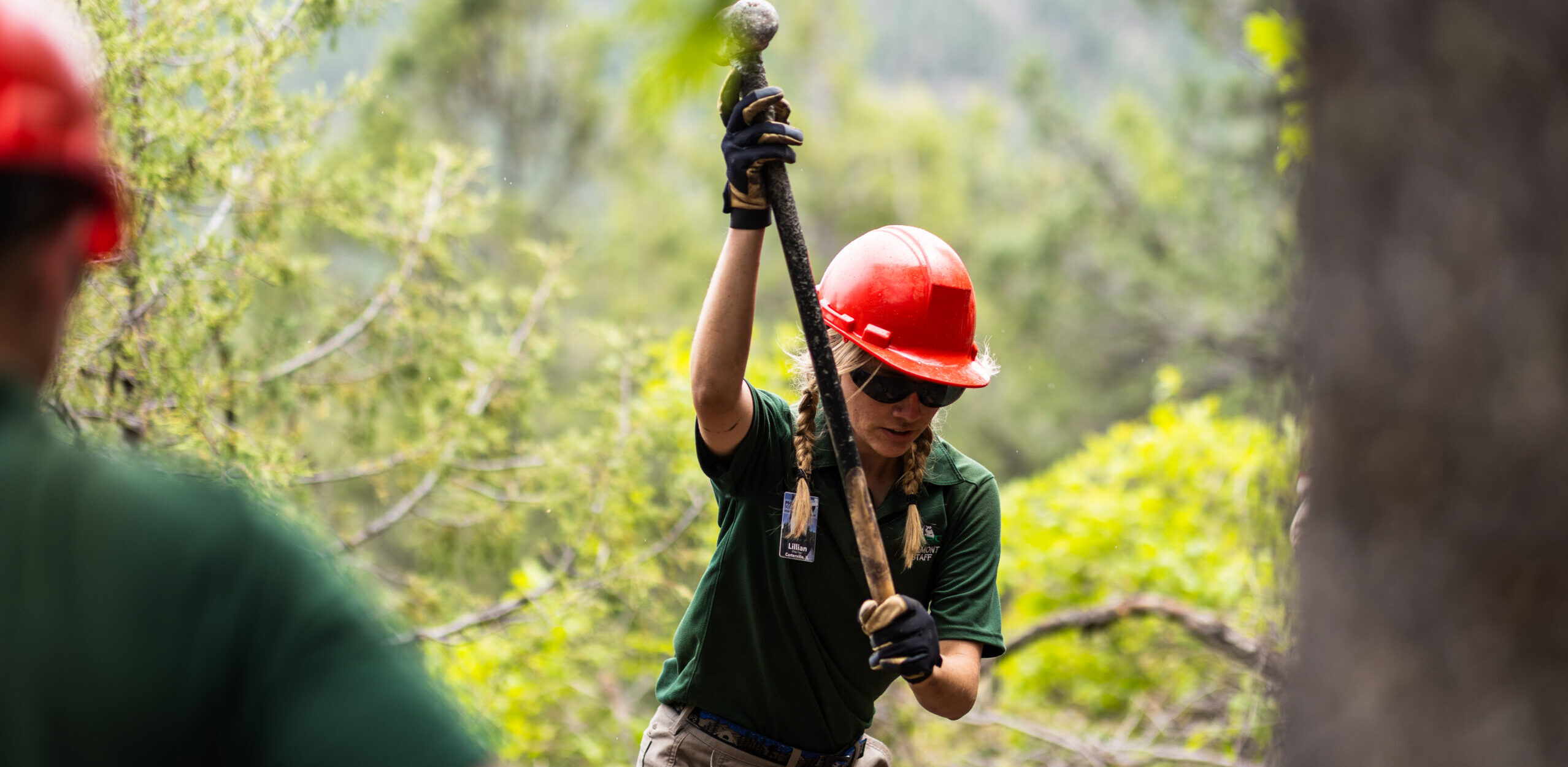
Environmental Educators take John Dewey’s words seriously on the ranch, using play-based, outdoor–classroom-style teaching methods. Founded in 1971, Philmont’s Conservation Department follows that philosophy through trail maintenance, forest management, stream restoration, and unconventional projects such as restoring backcountry burial grounds.
In 1943, Waite Phillips wrote to national council leadership, outlining the extensive work he performed on the ranch, from building “roads, trails, camps, the best of fences,” to his efforts to “develop springs, irrigation reservoirs… and other items of improvement too numerous to count.” With all his work and little external support beyond those of the camp operations, he stated, “What I am concerned about, therefore, is the conservation of these business properties.”
That concern took root. By 1971, the Conservation Department grew into what it is now: an integral part of the Philmont experience. Requiring three hours of work from any participant who completes a trek, it teaches Scouts the importance of hard work and leaves them with a sense of pride in having contributed to Waite’s vision for the ranch’s longevity.
In honor of that mission, Philmont offers three conservation-focused trek programs: Roving Outdoor Conservation School (ROCS), Training Crew Trek (TCT), and Order of the Arrow Training Crew (OATC), open to OA members. Each combines Environmental Educator-guided lessons, guest lectures, and hands-on outdoor experiences.
ROCS, which runs a week longer than the TCT and OATC, offers scouts an immersive 21-day program. Two Environmental Educators accompany each crew for 12-14 days of trek lessons covering everything from ecology to meteorology, with 40 hours of hands-on conservation work. Guest lecturers meet crews in the backcountry to speak on specialized topics, extending Philmont’s conservation outreach well beyond the ranch itself.
“I want to help them actually watch the earth turn,” Andrea Lommen said, an astrophysicist joining the 612 TCT as a guest lecturer this summer. Hoping to encourage Scouts not just to learn about the environment but to observe changes in the land firsthand. Danial, a Scout on the 612 TCT, noted his crew was able to “focus on one area for a very long time,” when asked what he liked most about his TCT.
So far, during their trek, the five 612 TCT Scouts have mentioned learning about the carbon cycle, rock types, the water cycle, and fire. At the time, they were sitting down for a Meteorology lesson in Lookout Meadow, led by Eddie Menso, Environmental Educator Coordinator.
Across the backcountry, both traditional and conservation crews have access to eight cons sites covering three areas of focus: forest management, stream restoration, and trail development. Scouts interested in forest management can plant trees at Cimarroncita and perform restorative thinning at Beaubien. Those drawn to trail building can develop trails at Elkhorn, Sioux, Sawmill, and North Fork Urraca. Scouts curious about aquatic systems can go to McCrystal Creek and Cito Creek to learn about Beaver Dam Analogs.
When asked what he learned on the trail, 612 TCT Scout Aarav did not recall a scientific name or a cloud formation, but rather a small sentiment that came up throughout his trek. “Appreciate the little things,” he said, reinstating that Philmont’s conservation work is not just about building trails and clearing forests; it’s about teaching the next generation of Scouts that this land is worth working for, one small project at a time.