In January 1891, Ernest Thompson Seton traveled to Paris to study and paint at the L’Academie Julian, an art school made up of expatriate Canadian artists. While the other artists in the school concentrated on painting classical representations of landscapes and human forms, Seton chose to paint his favorite subjects: wild animals, particularly wolves. His first effort was a wolf painted like one at the Paris zoo that he titled Sleeping Wolf. The painting was accepted in the prestigious juried show at the Grand Salon.
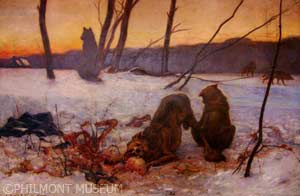
The next year, Seton began work on a large genre, or storytelling, world painting. He had read an unsubstantiated report in a Paris newspaper about a Pyrenees woodsman who was known for hunting sheep-killing wolves. One evening, the Pyrenees woodsman failed to return to his cottage. The next morning he was found dead, apparently killed by wolves.
The unproven story intrigued Seton and, given his compassion for wolves, he set about to put it on canvas. He titled the resultant panting, Triumph of the Wolves, giving it the implied moral that man cannot conquer nature and that man should respect nature rather than attempt to dominate it. Later, he gave it a second title, Awaited in Vain, which allowed it to be contemplated by the viewer either in sympathy for the wolves or the hunter.
Despite Seton’s demonstrated technical ability in carrying out the painting, it was rejected by the jury for the 1892 Grand Salon show due to its gruesome subject matter. However, the painting was hung in 1893 as part of the Canadian exhibit at the Chicago World’s Fair.